
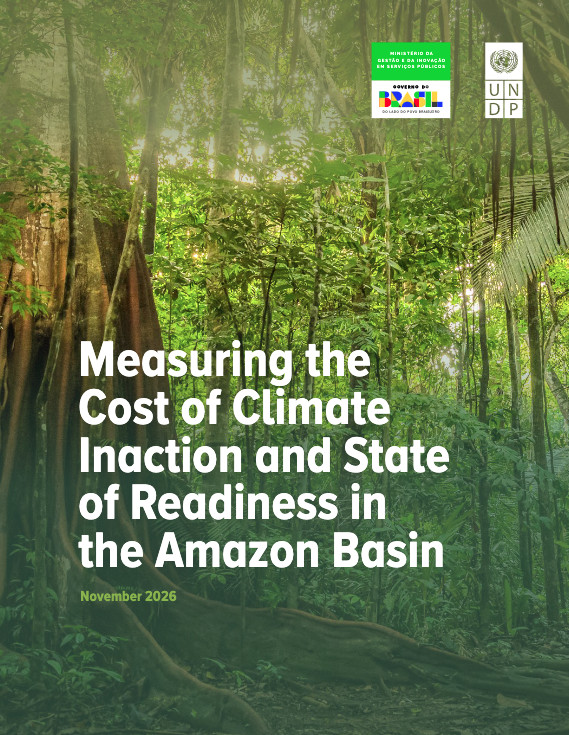
A new publication from UNDP measures the cost of climate inaction and how prepared the Amazon Basin countries are.
The United Nations Development Programme (UNDP) launched Measuring the Cost of Climate Inaction and State of Readiness in the Amazon Basin at COP31 in Türkiye, with contributions from Instituto Igarapé. One of the authors is Robert Muggah, co-founder of Instituto Igarapé and lead of Derisking Amazonia. The study draws on a systematic review of more than two decades of scientific research. It shows that the Amazon Basin is already under severe stress from rising temperatures, longer dry seasons, lower river flows and a higher risk of wildfires. The publication estimates that if nothing is done, the loss of ecosystem services, biodiversity and carbon storage capacity could cost the region between US$404 billion and US$941 billion by 2050–2070. That equals 14% to 33% of the combined GDP of the eight Amazon countries, based on their average annual GDP before the pandemic (2016–2019) of US$2.86 trillion.
Besides estimating the cost of inaction, the report proposes a framework for assessing how ready countries are to face these risks. It is built on four pillars: institutional and policy, operational and risk management, fiscal and economic, and community and social. It concludes that the region is not starting from scratch, but that the main challenge is implementation. Based on what each country already does, the study groups them into three pathways. Bolivia, Brazil, Colombia and Ecuador already have established strategies and institutions, and they need to build climate into their fiscal systems to scale up. Peru and Venezuela still have large areas of intact forest, and they need to turn conservation into economic value through bioeconomy value chains. Guyana and Suriname need to focus on basic capacities, such as adaptation infrastructure and administrative and financial management. The study also highlights agroforestry systems, productive restoration and de-risking investment as ways to build an economy based on the standing forest.
These findings tie directly to the purpose of the KYT-e platform: you have to know a territory to manage its risks, guide investment and turn commitments into real results. The platform’s indicators of territorial risks and opportunities can help governments, investors and entrepreneurs see where and how to act in the Amazon.
Read the full publication here
Explore data on Amazon municipalities on the KYT-e platform